Author Archives: mad

Just fix it

A couple days ago I found the most egregious error I’ve ever seen on wikipedia, not a graffiti issue, something that was wrong and had been wrong for a long time — since September 15 2004, on the DNA article. A picture of the chemical structure of DNA. It was in fact a “featured pictures” candidate for September 2004; it’s a little funny that all the comments about it failed to see the structure was wrong (a little sad, too).

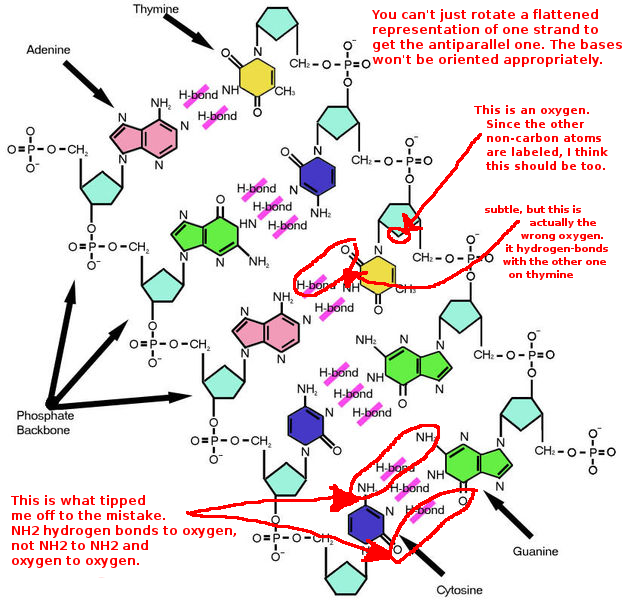
Below is my marked-up version that points out all the errors (click it to get more resolution).


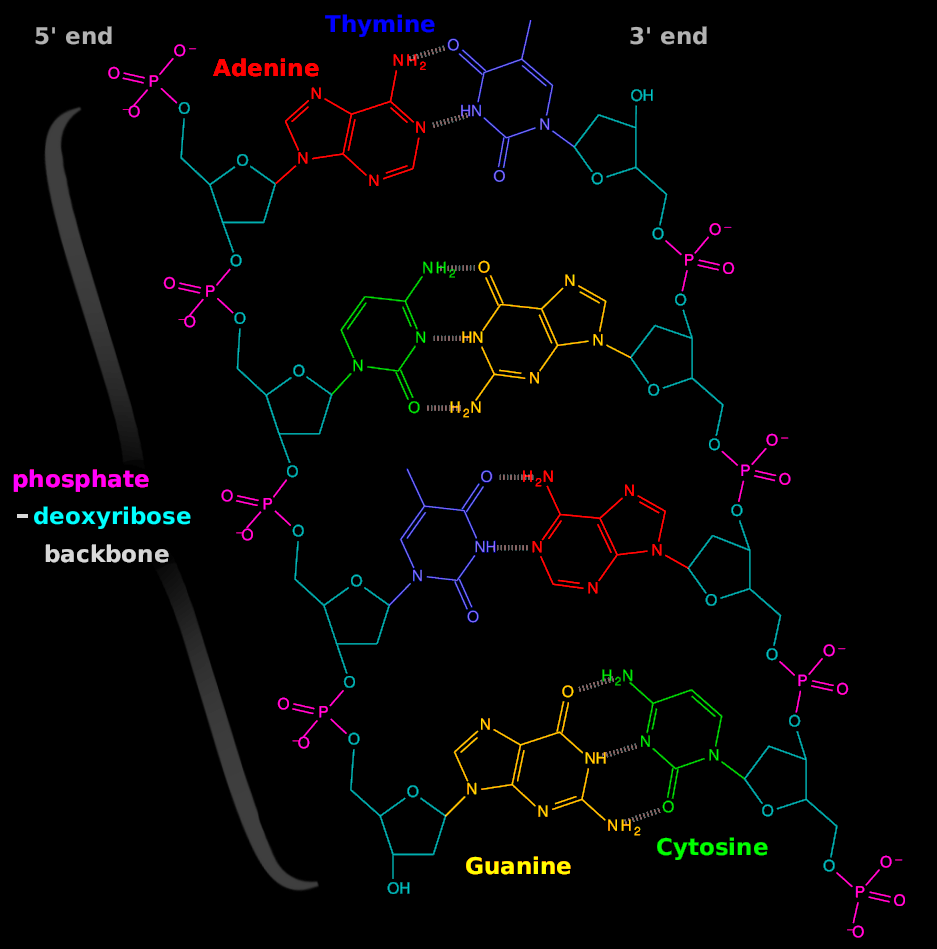
What I noticed, the immediate problem, was the base-pairing. In this picture the oxygens of guanine and cytosine were paired with each other, instead of with NH2. It looks like the author simply rotated a DNA strand 180 degrees and lined them up, not noticing that this actually fails to orient the bases appropriately. Maybe the problem is inherent in flattening a three-dimensional structure. Maybe it’s because the ribose connections of paired nucleotides are not opposite to each other, and this causes a “minor” and “major” groove in the backbones.

Anyway, I used ChemTool and GIMP to make a new picture and replaced all instances of the wrong-structure diagram with my new picture (in the articles DNA, Francis Crick, and GC content).


It took a long time, but I disapprove of people who complain about wikipedia errors without correcting them.

HDR Photos

On Thursday I was browsing the NY Times website while working ridiculously late, and I read this article online about “high dynamic range” photography. The problem: cameras saturate with too much light, failing to capture the full range in a scene. IE, with a short exposure the sky might be visible, but the foreground is so dark that it becomes a silhouette. On the other hand, with a longer exposure, you can see the foreground but the sky becomes a saturated white. By combining a series of photos taken at different exposures, and then remapping the values, you can create pictures which capture the land and sky. It’s beautiful stuff, you can see more in this Flickr HDR Photography group.

After reading this tutorial, I learned how to do a quick-and-dirty blending in GIMP to create reasonable “HDR” photos with a couple of layers and a mask. You define the saturated areas in the “overexposed” photo as the mask that instead exposes parts of the “underexposed” photo, thereby combining the two. I went outside (we live next to a picturesque pond) with my tripod and took a couple photos — unfortunately, my camera (a Canon PowerShot A95) doesn’t have automatic-exposure bracketing (“AE-bracketing”), so I had to adjust the exposures by hand. This means things moved around a bit in the photo, as a breeze was blowing.

The end result was still stunning.

Here is a medium exposure photo I took. The sky is saturated with white, and some of the foliage is lost in shadows.
Here the photo is very overexposed. You can see the foliage better, but the sky is completely white.
And in this one it’s very underexposed. The sky is vivid blue, but the rest is black.

Finally, here’s what I got using the quick and dirty manual masking method, combining the over-exposed and under-exposed photographs:

I love this, it’s beautiful. The next camera I buy will have to have AE-bracketing.

Bug Biomimicry – Eyes, Ears, and Minds

Sometimes mother nature inspires engineering. Sometimes especially hard problems are solved by organisms in ways we might not have imagined on our own. Bugs seem like unlikely muses, but they’ve inspired many an engineer.

Recently Science Magazine posted a news item about a synthetic lens that behaves much like an insect eye. The problem was this – how to create a very small camera that captures a wide angle light? A fisheye lens would be the obvious solution, but those are hard to create on a small scale.

Drawing inspiration from insect eyes, Jeoung, Kim, & Lee have created artificial compound eyes:

Now, I’m not clear on how detectors are set up to receive light that’s captured by the polymer, but the pictures sure look cool.

Multi-directional vision isn’t the only the only thing we have trouble miniaturizing – sound localization has also been difficult to miniaturize.

Humans seem to use the difference between the ears in volume of sound and time it takes to arrive to localize sounds. This was first described by Lord Rayleigh as the “duplex theory of localization“.

But this system can’t work for flies. With the speed of sound at 350 meters per second, a half a centimeter seperation of ears – huge in the world of bugs – only nets a 15 microsecond difference. Humans, with 20 centimeters of seperation between the ears, enjoy 600 microseconds. Now, human reaction time is at best around 300,000 microseconds; it’s amazing that 600 microseconds is enough to be preserved by carefully timed propagation through axons, but 15 microseconds is simply lost to neuronal noise.

But bugs can find noises! Ormia is a parasitic fly that likes to lay its eggs on grasshoppers, and it has ears that are a scant half millimeter apart. And yet they can localize sound as well as humans. They need to, to find the chirping male grasshoppers that will host as food and home to their parasitic children.

They accomplish this trick through linking the ears’ oscilliatory motions. This results in vibration differences – in both level and timing – between the two ears, caused by small differences in the timing of the sound’s arrival.

This clever solution has inspired engineers to create Ormia-based miniature directional microphones.

Finally, bug brains. Now, it’s true that bug brains aren’t very big, but bugs have interesting swarm properties. And when it comes to making robots, the simplest behaviors of living things are the most realistic thing we could try to imitate. No one falls for a talking pseudo-human robot, but a robotic bug really looks alive!

I heard about BEAM robots (Biology Electronics Aesthetics Mechanics, or something like that) from an article on Make magazine’s blog. While BEAM philosophy isn’t necessarily about bugs, that’s what these things look like.

The bugbots at the Maker Faire were solar-powered. Sunlight doesn’t give enough energy to continuously drive a motor, but capacitors can collect the energy to a critical point and release to create bursts of action. The bugs hop around in the sunlight, some of them attracted to it – moving towards their food source!

I really want to build one of these solar bugs. They sell kits at www.solarbotics.com and a lot of community (advice, guides, designs) exists at the solarbotics-hosted community at www.solarbotics.net.

Hacking BLAST

There are increasingly many biotechnology protocols which involve hybridizing small fragments of DNA to a large pool – methods that are sensitive to cross-hybridization. (PCR is less sensitive to this because it requires a pair of matches within a reasonable space and correct orientation, and bad matches can get weeded out by the exponential growth involved.)

So how do we check for a close match? Well, usually people run BLAST. But BLAST has been designed to look for evolutionarily close matches to a sequence — not matches close in free energy of hybridization. It’s the wrong tool for the job. It penalizes mismatches too heavily, and it treats A-T and C-G bonding as equivalent.

But I didn’t want to rewrite BLAST. It’d take me months or years. Well, we can hack BLAST to fit our needs. I’ve figured it out and wrote up a little HOWTO guide here.

No, Really, It’s Just Junk

I’ve been getting my little science news snippets these days from Science Now news (Science Magazine, unfortunately restricted access) and Nature News (unrestricted access). I look around for other news sources, I know there’s a ton out there. Today I looked at Seed magazine’s news.

The top article at the time was this one: “Junk (DNA) In The Trunk“.

The article’s opening paragraph…

“Finding a function for the 98.5 percent of our DNA that doesn’t encode for proteins – sometimes known as “junk DNA” for its jumbled, illegible arrangement – became a little less elusive last week. Geneticists from Johns Hopkins published an innovative way of using zebrafish embryos to test the purpose of non-coding human DNA sequences in the March 23rd online issue of Science Express.”

Oooooh, how mysterious! We don’t understand 98 percent of our DNA!

Actually, it’s not.

It’s not a mystery.

It’s a bunch of repetitive elements, parasitic self-propagating sequences that occassionally, in frenzied bursts of self-centered replication, manage to insert copies of themselves all around the DNA. They’re called transposons. 72% of our DNA is composed of retrotransposons, LINEs, and SINEs, three varieties of selfish, self-propagating junk.

This is just bad reporting. People should not propagate the mystical idea that there’s vast tracts of presumably functional DNA that remain a mystery to scientists. It doesn’t need a function! We’re pretty sure it doesn’t have much function. This sort of thing is vexing enough when it takes the form of science fiction but it’s totally unacceptable in science reporting.

Of course, the reporter did not actually get any facts wrong. He simply missed the point.

This really is something interesting here. Transposable elements have been a great tool for analysis of transcriptional promotion for Drosophila, and zebrafish is an animal much more relevant. What we really care about here isn’t the junk. We care about transcriptional regulatory elements, those small regions preceding genes, and maybe a few small distal elements, that determine when a gene is going to be expressed.

So, yes, there are interesting noncoding portions, but to conflate that with the 98.5% number and the term “junk DNA” is going to propagate the ignorant characterization of this stuff as being of mysterious function, when we’re pretty damn sure it ain’t.


… And, as if the world conspires to drive me apoplectic, Chris sent me a link to this article about the in silico simulation of a virus. But… what’s the point? I mean, sure, it’s an impressive computational feat, but what did they learn? The article failed to report on the results!

Here it is, in a quote from Nature News:

“The model also shows that the virus coat collapses without its genetic material. This suggests that, when reproducing, the virus builds its coat around the genetic material rather than inserting the genetic material into a complete coat. “We saw something that is truly revolutionary,” Schulten says.”

See, that’s an interesting result. The LiveScience reporter missed it.

Science reporting shouldn’t just be about mysteries and pretty toys. I wish science reporters didn’t keep misunderstanding science and missing the point of research — not just for the layman’s sake, but mine too, because I like reading about this stuff.

There are 10 types of people in the world….

“Those who understand binary, and those who don’t.” People like dichotomies and people like to simplify. Who wants to listen to the complex opinions of a fox when he could hear the simplified and polarized view of a hedgehog? (A reference to Tatkin’s analysis of political predictions .)

I was listening to more Long Now lectures. In particular, I’m thinking about Jim Carse’s talk. He’s the guy who wrote “Finite and Infinite Games”. He talked about belief. He set aside “belief” in its weaker sense to mean “opinions” and focused on what you could call the belief that is religious.

These are some aspects he observed:

  • Belief is based on a fundamental and unquestionable source, and the world is interpreted in light of this truth.
  • Belief cannot exist in a vacuum; a believer needs an unbeliever to exists in opposition to.

Not all belief is religious, nor do all religious adherents have this style of belief. Some communists have belief in this style, for example. The writings of Karl Marx are their source, capitalism is their opponent. And many religious people are spiritual rather than feeling a polarizing identification to the group.

In my personal reflections on the topic, I was thinking about science. It seems to me that one of the aspects of science is to reject this style of thinking. We might not be perfect at it (it’s human nature to dichotomize and simplify), but scientists try to question everything and take no single source as absolute truth. I think this difference causes misunderstanding. To the religious believer, he thinks a scientist simply has a different belief — that Darwin is his source, and religion his opponent. In this context, science becomes “scientism”, just one more belief to exist in opposition to.

PZ Myers linked to a study showing athiests to be “Americas Most Distrusted Minority”. I guess it’s disappointing. But really, it feels inevitable.

Since 9/11, we have been emphasizing religious tolerance. The propaganda we have heard is this: “Do not blame the Muslims, we respect and accept other religions into the fold of American society.” So, yeah, we still distrust Muslims some. But the dialogue has shifted. The Christian belief can’t exist in opposition to other religions, not if we’re encouraging tolerance.

Well, of course, belief needs an opponent. So the new opponent is natural. If you can’t exist in opposition to other religions, then you can exist in opposition to the anti-religion. For atheists to be the most distrusted isn’t surprising at all in light of recent propaganda encouraging religious tolerance.

When Nietzsche lamented the death of God, what he meant was the death of a belief in absolutes. But belief can be in Communism, in Scientology, in any number of things that can take the place of religious doctrine. Alas, I lament, I think Nietzsche was wrong. It is human nature to fix our world upon unquestionable truths.

DNA Comp… I mean, Nanotechnology

DNA is fascinating to us not merely because it holds information, but because its hybridization to a partner strand means it can recognize information. Release thousands of DNA sequences into a pool, and the simple thermodynamics of hybridization means each strand will end up finding its partner. Thus the dream of DNA computing – massively parallelized by the ability of many, many small pieces to diffuse and hybridize in a solution.

The famous example is the usage of this phenomenon to solve the “travelling salesman” problem , illustrated beautifully by Larry Gonick in Discover Magazine:

Unfortunately, the field of DNA computing dries up a bit after this. It turns out there’s a lot of cross-hybridization of similar sequences, and most computational problems simply can’t be posed in a useful manner in a DNA hybridization context. It’s sad, but the seemingly magical nature of DNA sequence and hybridization just don’t translate into computation the way we’d hope.

The field of DNA computation has morphed, moved on, to the field of DNA nanotechnology. While sequence hybridization can’t scale to practical computation, it can be used to create self-assembling structures. Hence the rather cute (if useless) structure gracing the cover of this week’s Nature…

So here’s some pics. There’s a guy in my lab that works on this stuff, he emailed the article to us and we’ve been ogling the pretty structures woven from DNA, created by Paul Rothemund at Caltech.


It still isn’t useful for anything yet. Well, that guy in my lab, he does have something useful. It’s not published yet. But it’s useful. The funny thing about it is that it’s entirely structural, the specific nature of DNA sequence isn’t used at all. In other words, someone said “we need something of this shape”, and DNA just happens to be material that shape is made of.

It’s a strange change from the fanciful computational nature of DNA sequence to using it as simple material for nanostructures. I think it’s a practical shift of focus. Making little smiley faces does feel like the latest in a long line of useless toy constructs, and a 2D grid limits applications quite a bit, but 3D constructions are possible (if a bit wiggly). Maybe people will realize structures they can use now that the tool exists to make them.


PS – Larry Gonick makes excellent science-based comics. I own his Cartoon History of the Universe. I think his cartoons are awesome.

PPS – I admit, half the reason I’m posting this is because smiley faces made of DNA are so damn cute. Albeit totally useless.
🙂

Bios and Zoe

I was listening to the Long Now lectures again, this one by Michael West on the subject of human life extension. I can’t say much of it stuck with me, but there was one topic that really caught my attention. And that was this: Ancient Greek had two words for life — “bios” for the life of an individual, finite and mortal, and “zoe” for the infinite and general phenomenon of life.

He applies this language to the contrast between the somatic tissue of our bodies and the germ line tissue of our gametes. The gametes are immortal, an unbroken line that extends back to the first life from which we all descended. They’ve never died. But every time they move through a new generation a set of cells is created to house and protect this royal lineage — our bodies. Thus, the body is the “bios”, the somatic mortal tissue of finite span. And that cycle of embryonic stem, germ stem, and gamete cells is the “zoe”, the immortal life that is unbroken.

After hearing that, of course, I thought Zoe was pretty much the best name ever to give one’s daughter. There she is, made from your immortal fragment, the part that can live on.

To my dismay, Chris pointed out that there’s already someone named Zoe Ball, a somewhat famous person. I was crushed. (I even whined about changing our last name.) Anyway, I’m passing along the name to you guys, in case you get any daughters and don’t know what to call them.

Dragon’s Teeth

I recently bought some dried dragon fruit at Trader Joe’s, because I’m a total xenophile. (At least, with respect to food — chicken feet? Hey, I’ve never tried that! Hm… chewy….) The dried fruit turned out to be not particularly sweet or tasty, really, but interesting in how terribly full of seeds it was. So I looked up some images of dragon fruit on the internet.

Well, dragon fruit is the fruit of a cactus. One page I found talked about growing up plants from the seeds of fruit acquired at the market.

The cool thing about this is this image in particular:

I’d never thought about it – are cacti monocots or dicots? (Monocots have seeds that form a single leaf, dicots have seeds that have two halves and form a pair of leaves – more info here.) Cacti don’t have leaves! But they do, when they first grow, in their vegetable version of an embryo. Cotyledon leaves are like leaves, but not true leaves, and that’s what that picture is. They don’t look like cacti at all! It reminded me of the ontogeny/phylogeny thing — embryonic humans look like fish, and embryonic cacti look like leaved plants.


PS – the dragon’s teeth name given to the jpg is a cute reference to this myth.

PPS – I admit, cacti can have leafy things, technically speaking, sticking out near their needles in a structure called an “areole“.

Lost Languages

I transcribed this because I thought it was an interesting story:


Going back to Roosevelt, the environmental movement — the most powerful part of it — really did arise from the upper class. There’s no question about it. But people in that class like (George) Perkins Marshall and so forth really made a separation between society and human beings, and nature itself.

But Native Americans and, if you look at the native languages from all

the Americas — Northwest America and South America — what you find is

a very, very different set of perceptions that inform their relationship

to the environment.

I was reminded of this when I was in Patagonia several years ago,

climbing with some friends, and there was a very tawdry little museum

there of an extirpated tribe called the Yaghan or the Yamana people.

These are the people that Magellan spotted when he came around Tierra

del Fuego and he called them beasts. He called them beasts because when

he looked at them, they were bathing in the winter at the seashore,

they’d taken off their furs, they were rubbing themselves down with

salt water, and steam was coming off their bodies. And he called them

beasts.

When the Czechs and Germans came and created the great estancias in

Chile and Argentina for wool, for the Hobbesian “dark satanic mills” of

the Industrial Revolution, these natives were bountied at twenty-five

dollars a head and they were rounded up until they were finally in one

mission, an Anglican mission, and this mission was headed by a priest

who was an amateur lexicographer. He loved words. His father, however,

was involved with an earlier massacre of the same people. So even though

they were there and there was only a few hundred of them left, they

didn’t trust him, because of his father’s involvement with this

massacre. So they wouldn’t talk to him, just the tribal chief started to

tell him their language and give him the definition of the words. He

wouldn’t talk about women’s issues, cosmology, ritual initiation, you

know, certain things that were taboo, because those weren’t to be given

to just anybody, but he would talk about everything else. He got to

30,000 words and the Anglican lexicographer died.

Now that dictionary is in the British Museum. Just to give you some

sense, there’s 40,000 words in Japanese. This dictionary’s 30,000 words,

one person, all memory, and no written language. This language has more

verbs than English. And this language, when you read the dictionary

is, in a sense, “local science”. This is a language, when you read it,

where the sacred, survival, hunting, gathering, and psychology, are not

integrated, they were never dis-integrated.

And so, the terms for spiritual states and the terms for psychological

states are all poetically metaphorical of the science of place. So

“i-ka” is a verb, and means: “lying in your canoe in the morning before

dawn, listening to the rushes brush against the bark”. “What were you

doing this morning?” “Oh, I-kan…” Their word for depression is a crab

who is molting its shell and hasn’t dropped it yet, it hasn’t lost the

old shell yet. The language is exquisite. Now if you take seven people

here who are college-educated, and lock them up for a week, they’ll come

up with 12-15,000 words.

This is the beast that Magellan saw. These were the people who were

bountied. This is a language that we don’t understand, because what

we’re trying to do is bring this together (society and the environment)

and these are people that never separated. So, in a sense, the framing

of environmentalism arose — and this is what I think — from a great

love of nature, but also came from a sense of alienation and separation.


Paul Hawken, “The Long Green”. Oct 2004, Long Now Seminars

http://www.longnow.org/shop/free-downloads/seminars/