Assuming the worrier in this xkcd comic is a woman — I think the size of one’s dating pool is the last worry on a young lady’s mind. Here’s my geeky version on the subject.

Assuming the worrier in this xkcd comic is a woman — I think the size of one’s dating pool is the last worry on a young lady’s mind. Here’s my geeky version on the subject.
An online essay on the Nature website by Phillip Ball (no relation) caught my eye, titled “Arthur Eddington was innocent!” The subject is Arthur Eddington‘s famous test of Einstein’s theory of relativity, in which he compared the observed locations of stars during a solar eclipse to Newtonian and relativistic predictions.
Later historians have noted that Eddington’s analysis discarded data from a telescope that did not fit the relativistic predictions. Because Eddington was a supporter of Einstein at the time, the implied accusation is that the experiment was biased and unjustifiably promoted as confirmation of Einstein’s theory. However, recent re-examination of the data by Daniel Kennefick concludes that it was not Eddington who chose to discard this data but Dyson, leader of the expedition and much less likely to deliberately discard data in order to favor Einstein’s new theory.
I’d like to add to this record of unfair cynicism – I looked into another famous accusation of a lack of scientific integrity while working on Wikipedia genetics pages. In 1936 the statistician R.A. Fisher observed that Mendel’s results were “too good to be true”. Many have popularized this to imply that Mendel fudged his data (although the ratios he observed were not incorrect). A 2001 review by Fairbanks and Rytting conclude that there are botanical and statistical reasons that could explain Mendel’s results. In addition, they note that Mendel published only a subset of his experiments — it is not surprising that he may have published the better numbers.
Phillip Ball concludes,
The motto of the Royal Society — Nullius in verba, loosely translated as ‘take no one’s word’ — is often praised as an expression of science’s guiding principle of empiricism. But it should also be applied to tellings and retellings of history — we shouldn’t embrace cynicism about how scientists do their work just because it’s become cool to knock historical figures off their pedestals.
I like learning about the uncertain paths that the history of science has taken, but I tend to bristle in response to this other type of relativism — one that cynically reduces it to the status of social construct. Scientists are fallible and human, but the overall process generally contains an earnest desire for truth and discovery. I prefer this middle path between cynicism and idealization.
Mako pointed out that the spam filter was blocking legit (ie, his) comments. I doubt anyone is reading this blog much, but I’ve updated to Typo 4.1.1 which has much better spam handling so hopefully comments work now. Unfortunately, it broke the Lush theme, so for now I’m stuck with a default.
First round with scrub brush and lysol. Second round with heavy duty magic eraser.

I discovered a cool google image search term: cross section. Seeing the inside of things — all types of things — is fundamentally fascinating.
 |
 |
 |
 |
As Schrödinger so famously demonstrated, whenever one is illustrating fundamental scientific principles, the optimum choice for such an illustration is a cat. In that spirit, I’d like to present one of my favorite examples of how fundamental biology phenomena are visible in our everyday life.
Some background: Gene copy number is important. Variations in gene copy number are, perhaps, a subtle sort of problem — having 50% more or less copies of a gene available for expression is conceivably a minor thing in the biochemical world, where feedback loops regulate gene expression to increase or decrease as necessary. (That’s why so many disorders are recessive; as long as one functional copy of a gene exists, things seem to work fine.) Nevertheless, the duplication or deletion of entire chromosomes has a severe effect. Within the autosomes (non-sex chromosomes), no cases of chromosome loss are viable. The only extra chromosome that is mild enough to be viable in humans is trisomy 21, which causes Down syndrome. Chromosome 21 is the smallest autosome.
Because of this, when it comes to the sex chromosomes, mammals are faced with a copy number problem. Males (XY) have only one copy of the X chromosome, while females (XX) have two. The ways biology addresses this issue is called “dosage compensation“. In mammals, dosage compensation is achieved by randomly inactivating all but one X chromosome in all cells. Thus, regardless of an animal being male or female, only one X chromosome is active in any given cell.
This X-inactivation occurs early in embryonic development. Once a cell has decided to inactivate a given X chromosome, that decision is inherited by all its daughter cells. As a result, female mammals exist as a “mosaic” of X-inactivations — in their bodies, whole patches of tissue have one or the other X inactivated.
An interesting consequence of X-inactivation is that, unlike genes on other chromosomes, only one allele of a gene on the X chromosome is expressed in any given cell. This phenomenon is easily visible in tortoiseshell cats — tortoiseshell coloration arises from X-inactivation, so these cats are almost always female. The coat color gene, which has alleles for orange or black coats, exists on the X chromosome. Because of X-inactivation, only one of the two genes is active in various patches of skin, giving rise to a pattern of orange and black patches. Since the process of X-inactivation is random, this pattern of patches is random.

I love this example of X-inactivation so much, I added a picture of a kitty to the wikipedia page on X-inactivation. It’s always cool to have a everyday visualization of what would otherwise be an abstract genetic and developmental phenomenon.

It turns out the double sunset Luke Skywalker watches on Tatooine isn’t as fantastic as we might have assumed. A group of astromers led by David Trilling using the Spitzer space telescope to view the infrared spectrum (which allows them to see the disk of dust associated with planet formation) have concluded that planets are at least as likely to form in double star systems as in single.
I read about this in Science Magazine news, but since Science cuts off access to old news items, here’s a link: a spacedaily.com report that hopefully won’t go bad. Also, I discovered the Spitzer telescope podcast series, which has featured this story in a recent podcast.
In the Science news article, Phil Berardelli wrote:
The discovery should serve as another cautionary tale for anyone who relies too much on our own solar system as a model, says astrophysicist Mario Livio of the Space Telescope Science Institute in Baltimore, Maryland. Astronomers used to think that all gas giant planets such as Jupiter would be far from their suns, for example, he says. But they’ve now found several “hot Jupiters” close to their stars. Likewise, Livio says, we should no longer assume that one-star systems are the ideal planet breeding grounds.
Which got me reflecting on the larger phenomenon. It’s hard not to make assumptions based on what we see around us, but Earth — and so much of what we see on and around it — is only a sample size of one.
In an ambitious attempt to transform our current scientific abilities, the X Prize foundation has announced the much-anticipated sequencing prize. 100 human genomes in 10 days is a hard task indeed, but harder yet? Doing it left-handed!

| DNA is, of course, a right-handed helix. I was alerted to this invasion from the mirror universe by the Left Handed DNA Hall of Fame, where you can find a collection of many entertaining mistakes. |

|
I know it’s nit-picking, but I found this photo in Science magazine reporting on a prize specifically meant for DNA technology, so I find the X Prize Foundation’s error especially deplorable. For them to get that sort of thing wrong… well, it hints at a disconnect with the actual science, obliviously taking artistic liberties in the pursuit of some media attention.
(Science 13 October 2006: Vol. 314. no. 5797, p. 232)
It seems to me that the prize conditions also reflect hype and media-pandering rather than a sincere understanding of efforts to improve sequencing technology. 10 million for 100 genomes in 10 days? Why is speed important? Why not encourage low cost sequencing? There was no cost limit announced; a company could conceivably spend much more than 10 million merely to get the prestige of the prize. That is, after all, what happened with the space prize.
If you were getting your genome sequenced, which would you rather buy: a one day wait for $100,000? Or a three month wait for $1,000? You’ve lived with those genes for decades, I doubt you’re eager to spend a lot more money just to find out a little sooner. The real future is in cheap sequencing, not fast sequencing.
PS – Yeah, I know zDNA is left-handed, but you can’t honestly think that this artist was intending to represent that.
PPS – What drew my eye to the picture initially were other aspects — even flipped, this is a terrible representation of DNA. There should be only 10 bases for every turn of the double-helix (I see about 20 here). Also, the two helices are evenly spaced; they should be closer to each other so they look more like a pair twisting around (as in the cartoon), thereby forming the “major” and “minor” grooves of DNA. Lastly, the helix looks stretched-out… it isn’t twisting nearly enough with respect to its width.
A couple days ago I found the most egregious error I’ve ever seen on wikipedia, not a graffiti issue, something that was wrong and had been wrong for a long time — since September 15 2004, on the DNA article. A picture of the chemical structure of DNA. It was in fact a “featured pictures” candidate for September 2004; it’s a little funny that all the comments about it failed to see the structure was wrong (a little sad, too).
Below is my marked-up version that points out all the errors (click it to get more resolution).
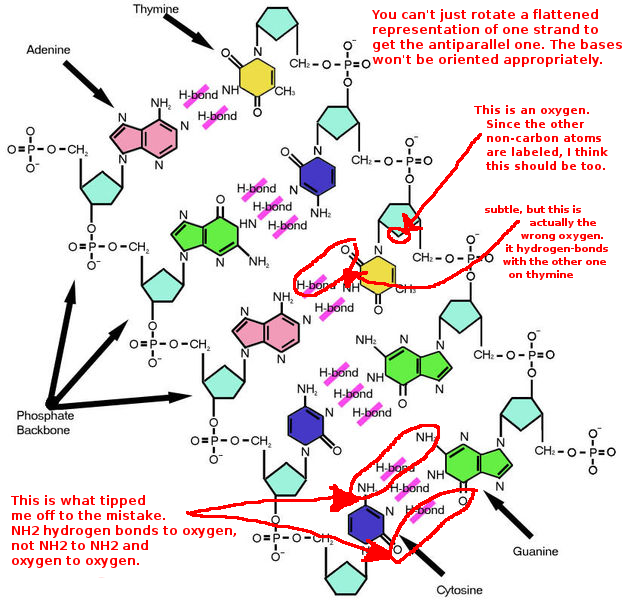
What I noticed, the immediate problem, was the base-pairing. In this picture the oxygens of guanine and cytosine were paired with each other, instead of with NH2. It looks like the author simply rotated a DNA strand 180 degrees and lined them up, not noticing that this actually fails to orient the bases appropriately. Maybe the problem is inherent in flattening a three-dimensional structure. Maybe it’s because the ribose connections of paired nucleotides are not opposite to each other, and this causes a “minor” and “major” groove in the backbones.
Anyway, I used ChemTool and GIMP to make a new picture and replaced all instances of the wrong-structure diagram with my new picture (in the articles DNA, Francis Crick, and GC content).
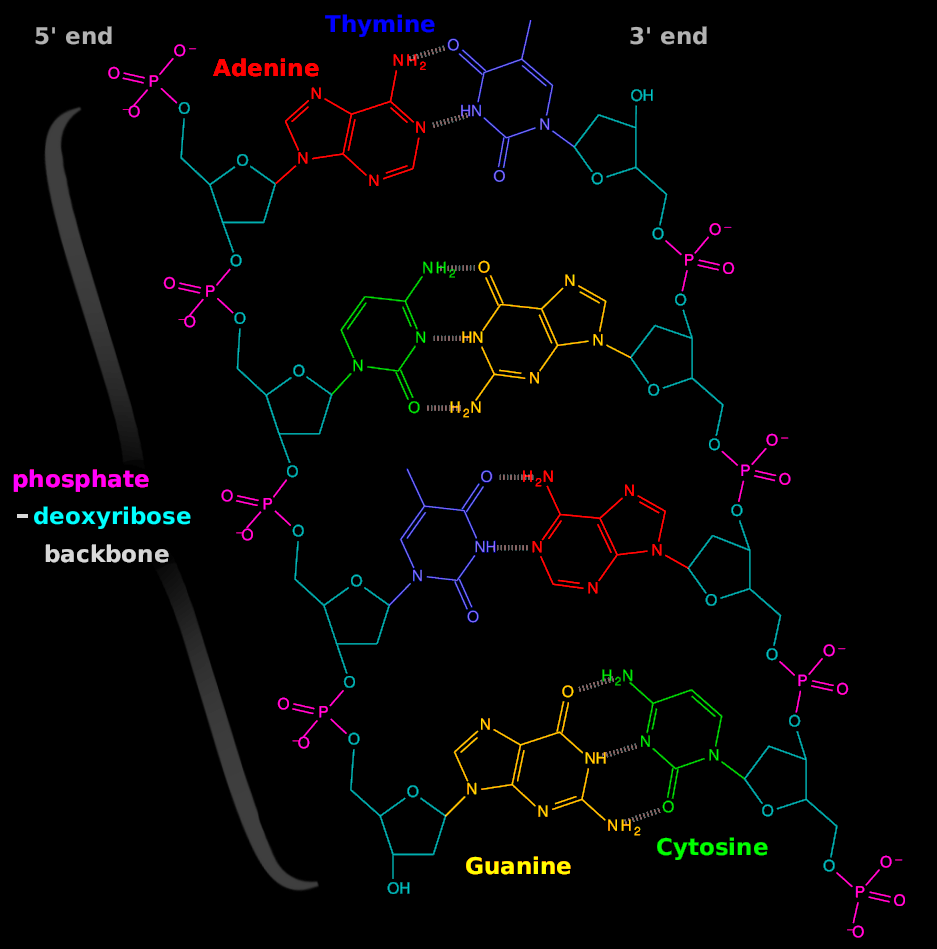
It took a long time, but I disapprove of people who complain about wikipedia errors without correcting them.
On Thursday I was browsing the NY Times website while working ridiculously late, and I read this article online about “high dynamic range” photography. The problem: cameras saturate with too much light, failing to capture the full range in a scene. IE, with a short exposure the sky might be visible, but the foreground is so dark that it becomes a silhouette. On the other hand, with a longer exposure, you can see the foreground but the sky becomes a saturated white. By combining a series of photos taken at different exposures, and then remapping the values, you can create pictures which capture the land and sky. It’s beautiful stuff, you can see more in this Flickr HDR Photography group.
After reading this tutorial, I learned how to do a quick-and-dirty blending in GIMP to create reasonable “HDR” photos with a couple of layers and a mask. You define the saturated areas in the “overexposed” photo as the mask that instead exposes parts of the “underexposed” photo, thereby combining the two. I went outside (we live next to a picturesque pond) with my tripod and took a couple photos — unfortunately, my camera (a Canon PowerShot A95) doesn’t have automatic-exposure bracketing (“AE-bracketing”), so I had to adjust the exposures by hand. This means things moved around a bit in the photo, as a breeze was blowing.
The end result was still stunning.
| Here is a medium exposure photo I took. The sky is saturated with white, and some of the foliage is lost in shadows. |  |

|
Here the photo is very overexposed. You can see the foliage better, but the sky is completely white. |
| And in this one it’s very underexposed. The sky is vivid blue, but the rest is black. |
 |
Finally, here’s what I got using the quick and dirty manual masking method, combining the over-exposed and under-exposed photographs:

I love this, it’s beautiful. The next camera I buy will have to have AE-bracketing.

