Reposted from Google+
If you has trubble wif respectin teh LOLspeaks, heer is awsum explanashuns!1
No srsly, I noes dis are not profeshunals — but is interestin stufs.

Reposted from Google+
If you has trubble wif respectin teh LOLspeaks, heer is awsum explanashuns!1
No srsly, I noes dis are not profeshunals — but is interestin stufs.
Reposted from Google+
I noticed this colorful new set of instructions for the -70C Freezer door latch… repetitive warnings have been a theme with this latch, but this version is really nicely done!

It’s been a full year since I last posted here. I’m posting here again because I’ve joined Mako’s Iron Blogger, and the set-up I had for using my Google+ posts is now broken. So I’m reposting my latest Google+ post, which happens to be exactly the same topic as my last post a year ago.
As we have done the past two years, Chris and I are donating to various causes for our wedding anniversary: 6% of our pre-tax income for 6 years of marriage (next year it should be 7%, etc.). We announce it publicly hoping to prompt others to make similar efforts to give more — and to give effectively. Our anniversary was actually October 29, but our choices were delayed as we waited for GiveWell’s recommendations on effective charity organizations (which were released Tuesday Nov 29th). Our choices are split 50/50, below is my planned breakdown:
40% to the Against Malaria Foundation (AMF): This is one of GiveWell’s two top recommendations this year. AMF distributes insecticide-treated nets for protecting against malaria infection. GiveWell estimates the cost per life saved is just under $2,000 — malaria is not usually fatal, so this means a fair amount of disability due to illness is also being prevented.
40% to the Schistosomiasis Control Initiative (SCI): This is the other of GiveWell’s two top recommendations. SCI assists in the treatment of neglected tropical diseases in Africa, in particular schistosomiasis and soil-transmitted helminths (both parasitic worm diseases). While the diseases SCI treats are not generally fatal, they create a large burden of chronic illness and disability. I believe reducing this burden is important to creating lasting change in developing countries as a healthier population is more able to contribute to and improve society. GiveWell estimates overall cost per treatment is around 50 to 80 cents, depending on how conservative estimates are.
8% to GiveWell itself. GiveWell continues to guide our giving by doing extensive research on the effectiveness of charity organizations. This is not a trivial issue: oversight can be quite sloppy and the incentives of competing for donations can push organizations to advertise ridiculously optimistic numbers. “For just $1 you could save a life!” fails to capture the statistical reality that a life is saved by that particular $1 only a tiny fraction of the time. A realistic and honest accounting of overall effectiveness is needed for charitable giving (even the most effective charities, by GiveWell’s estimates, achieve a cost-per-life-saved in the $500-$1000 range).
The remainder of my giving is targeting organizations which affect the society around me, rather than direct poverty relief. I think these organizations benefit society in a more general and long term manner — it is less measurable, but hopefully these make important differences in my society and the world, in the long run.
4% to the American Civil Liberties Union (ACLU): Technology is increasingly able to surveil and restrict individuals in targetted and invisible fashions that can leave most of society unaware of the consequences. In addition, I believe the recent Occupy movements are addressing an important issue in our society: the deepening gap of income and social inequality. Technological progress will only support this concentration of wealth in a few individuals as we become more and more able to automate and crowdsource tasks, reducing the number of individuals employed to accomplish them (even highly professional tasks!). I hope the ACLU represents an organization that will protect individual freedoms and protect grassroots civil movements like Occupy.
4% to WBUR (Boston public radio): Public radio’s news is how I shape my understanding of the world and has led me to the awarenesses I have now. I am optimistic: I believe simply hearing broad and balanced reporting (and I do believe it is usually fairly balanced) about the world and events will lead others to think responsibly about how to help others and benefit society.
4% to Wikipedia: In keeping with that theme — that simple knowledge is part of the power to create change — I support Wikipedia. Wikipedia’s local effect is obvious, we all use it in our daily lives. It also serves as another form of reporting, instantly updating in response to current events. Globally, I see it as potentially the single cheapest way to disseminate knowledge to the developing world. For now I trust that individuals will find ways to access the internet and Wikipedia’s store of knowledge, and I support Wikipedia itself for being that repository.
Why we give: Our giving began after reading Peter Singer’s The Life You Can Save. Each year we increase that amount — while projections for our pattern may seem unrealistically large in the distant future, for now we trust ourselves to get used to it (not unlike the apocryphal frog in a pot). Peter Singer himself began giving 10% of his income in graduate school (a notoriously low income lifestyle) and now gives 25% (note that he has raised three children with his wife Renata while doing this). Giving so much all at once is too much to expect of anybody, but we hope that by committing a little more each year we grow closer to such an ideal.
Every year it feels like I have a little more to be thankful for: my family, my marriage, my work. I regret missing Thanksgiving with my parents and siblings this year, but am thankful that I have friends here in Boston to spend it with. We’re putting together a vegetarian/vegan feast! There are rumors of a tofurducken.
One of the many things I’m thankful for is meeting Chris. Our five year anniversary was nearly a month ago, and to celebrate we are dedicating 5% of our pre-tax income to charity. (We did the same last year, 4% for our fourth. Acquaintances ask “how is this going to scale?”, and I respond “I highly doubt I’ll live past 120.” (In truth, we may not be able to keep up once we have children, but for now, this is our ideal.))
So, why am I telling you? I know, it sounds like I’m bragging — I’m not actually trying to win any awards with this. I want to let you all know about my choices during this season of giving in the hopes that those of you who also feel lucky and generous might be similarly inspired.
The best giving is one which tries to have the best impact. Both of us have chosen a split along several organizations which have a significant impact on improving human lives, or which have an impact on social things which we believe have an important long term impact on the world.
My choices:
Chris will post his own 100% split on his blog. We have averaged them and will be donating the money in the next few days. I’ve had the astounding luck to be given a life bountiful (at least… by global standards) in tangible and intangible wealth, and thankful that I’m able to give some of that back to world. To those of you who don’t feel able — I don’t encourage you to give right now, but to just think that someday, when you feel like you’re lucky and able, to think about it.
Chris was out of town last weekend and I needed to unwind, so I joined some friends on a road trip to DC to attend the Rally to Restore Sanity. According to estimates based on aerial photography the crowd was over 200,000 — this includes my sister Suzy, who I never did see!
I’ve uploaded photos to Flickr taken with my crappy camera phone. I typed out lots of descriptions for each photo — if you want to learn more about the trip make sure to read those. 🙂
We stayed at Kat & Greg’s house; Kat also took some great photos with a digital camera (i.e. superior to my phone).
I’ve decided an online ordering system I’ve been using is actually an interactive modern art piece, designed to provoke a response in the viewer to the experience of bureaucracy. Emotions of helplessness, confusion, and frustration are created through the thoughtful assembly of layers, pages, numbers, and forms. With this new appreciation I find my heartrate subside — I chuckle at how I was manipulated by such clever design.
I don’t know how I found time to do this. It didn’t take that long. I was supposed to do a 4th-of-July patriotic theme but got distracted.

I defended last Thursday. People claim I gave a good talk. My sister (who is pretty nonscientific) claims she understood large segments of it!
Chris recorded the talk with audio and video. It was hard to read the slides on the original video, so he’s created a video using the audio only and pics of the slides themselves.
I should watch it myself, but dislike the sound of my own voice… I think I sound like a chipmunk. Honestly, in my head my voice is much deeper than that.
Anyway, if you take the time to watch, I hope you enjoy it! The subjects are epigenetics, DNA methylation, and a little on clinical analysis of whole genomes (related to the Personal Genome Project).
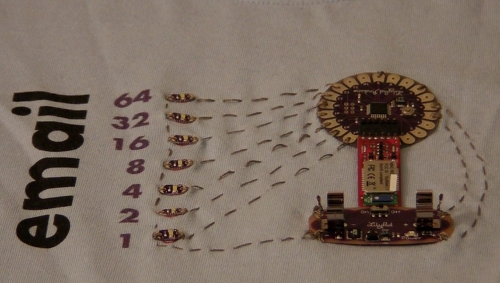
Since Chris’s blog post about his t-shirt seems to have been a hit, I should post about it here as well. The story is this … Chris has been wanting to learn electronics for a while, so when SparkFun Electronics had a give-away in January he jumped at the opportunity and got $100 worth of electronics (this deal was given out to 1000 people). This stuff included a LilyPad Arduino and LEDs, etc. For a while Chris brainstormed on what to make with it and decided to make a T-shirt that reports how many emails are in his inbox.

I helped out too, I’m responsible for the design: vertical binary LED layout, the custom T-shirt printing (from cafepress), and all the placement and sewing of items onto the shirt.
More recently we attended PAX East this weekend. On Friday Chris wore another custom shirt we ordered from Cafepress (pictured on the right). The idea for the text was entirely Chris’s (he came up with it over beer at a post-Libre Planet party at the Acetarium); Mako suggested the font choice (Impact). I think it’s hilarious. If you don’t get it, try watching this Daily Show Chatroulette skit.
My physic friends network confirms that this is not a hoax:
http://en.wikipedia.org/wiki/Color_confinement
Here is the lead pic and accompanying caption:
The color force favors confinement because at a certain range it is more energetically favorable to create a quark-antiquark pair than to continue to elongate the color flux tube. This is analoguous to the behavior of an elongated rubber-band.
Quick, reroute the color flux tubes to divert color force into the hadron jet! (The principle is simple, really, it’s just a rubber band but made out of pair-bonding quarks.)
Biologists and other fields have been content to develop their secret lingos using a few new words and a lot of acronyms. It never occurred to us to simply re-use common words to mean utterly different things so that when I’m talking about “underpants” I actually meant “retrotransposons”. That genius is reserved for physics.
